Home > Products > API Peptide
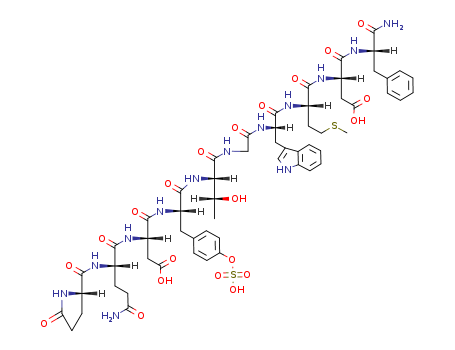
MF: C58H73 N13 O21 S2
|
Discovery |
Caerulein is a peptide secreted from the skin of frogs. Caerulein shares the conserved C-terminal sequence that is responsible for receptor activation with vertebrate gastrin and cholecystokinin (CCK), and functions as their agonist.?Caerulein was first described in a number of Australian amphibians as a polypeptide that stimulates pancreatic external secretion and elicits a decrease in blood pressure and extravascular smooth muscle contraction in mammals. Caerulein was first purified from the Australian tree frog Hyla caerulea in 1967. |
|
Structure |
Caerulein is a decapeptide that contains the C-terminal four aa sequence (Trp-Met-Asp-Phe-NH2) that is conserved in the vertebrate gastrin and CCK. A pyroglutamate residue is present in the N-terminus, and a C-terminal phenylalanine residue is amidated. Caerulein possesses a sulfated tyrosine at the seventh residue from the C-terminus.??Two caerulein precursors, preproCPF-St6 and preproCPF-St7, have been reported in the western clawed frog Silurana tropicalis. The precursor contains a signal peptide, an antimicrobial peptide called a caerulein precursor fragment (CPF), and mature caerulein. Caerulein has been identified in various frog species, including Xenopus laevis, Litoria splendida, and Hylambates maculatus. Sauvage’s leaf frog, Phyllomedusa sauvagei, possesses a caerulein-like nonapeptide called phyllocaerulein. These peptides share the C-terminal four aa sequence. Caerulein 1.2 of the magnificent tree frog, Litoria splendida, does not have the consensus 4-aa sequence (Trp-Phe-Asn-Phe-NH2).?Mr: H. caerulea caerulein, 1352. Caerulein is soluble in DMSO, but insoluble in acetone and diethyl ether. |
|
Gene, mRNA, and precursor |
In S. tropicalis, two caerulein precursor genes have been identified, and they have a four-exon structure. Two caerulein mRNAs are 428 and 418 bases in length and encode precursors of 98 and 91 aa residues, respectively. |
|
Synthesis and release |
In X. laevis, a caerulein-like substance is released in response to adrenaline treatment. This substance stimulates the contraction of the guinea pig gall bladder and pancreatic secretions in rats. Amino acid analysis of the secreted substance shows a similar aa composition to that of caerulein. Seasonal changes in caerulein synthesis have been reported. For example, L. splendida synthesizes caerulein during the reproductive season in summer. In winter, the synthesis of caerulein is less active. Also, the desulfated form of caerulein increases and caerulein 1.2, which has relatively low biological activity, is released. |
|
Biological functions |
Treatment of the outside of frog skin with caerulein results in an influx of sodium ions while treatment of the inside of frog skin represses sodium ion influx. These results suggest that caerulein is associated with the maintenance of sodium ion levels in the dermal cells. In addition, preprocaerulein contains antimicrobial CRF, and caerulein can affect gastrin and CCK signaling in other animals. These suggest that CRF and caerulein may function as defensive peptides against microbes and predators in the frog. |
|
Clinical implications |
Caerulein is used to generate rodent models of pancreatitis. Caerulein acts as an agonist of CCK1R and CCK2R because of its structural similarity to gastrin and CCK. Treatment with a high dose of caerulein induces the secretion of pancreatic juice and results in acute pancreatitis in rodents. |
|
Manufacturing Process |
The tetrapeptide, L-pyroglutamyl-L-glutaminyl-L-aspartyl-L-tyrosine-azide (I), is condensed with the hexapeptide, L-threonyl-glycyl-L-tryptophanyl-L-methionyl-L-aspartyl-L-phenylalaninamide (II), having the hydroxyl of the threonyl radical blocked by an acyl radical in a suitable solvent, such as dimethylformamide, to obtain the decapeptide, L-pyroglutamyl-L-glutaminyl-L-aspartyl-L-tyrosyl-L-threonylglycyl-L-tryptophanyl-L-methionyl-L-aspartyl-Lphenylaninamide (III) having the hydroxy group of the threonyl radical blocked by an acyl radical. The decapeptide (III) is treated, at low temperature, with the complex anhydrous pyridine sulfuric anhydride finally to obtain the decapeptide, L-pyroglutamyl-L-glutaminyl-L-aspartyl-L-tyrosyl-L-threonyl-glycyl-L-tryptophanyl-L-methionyl-L-aspartyl-L-phenylalaninamide (IV) having the phenolic group of the tyrosyl radical protected by a sulfate radical and the hydroxyl of the threonyl radical protected by an acyl radical.Finally, by mild alkaline hydrolysis of the decapeptide (IV) one obtains the decapeptide product. |
|
Therapeutic Function |
Stimulant (gastric secretory) |
|
Hazard |
A poison. |
|
Safety Profile |
A poison by subcutaneous route. When heated to decomposition it emits toxic vapors of NOx and SOx |
|
Definition |
ChEBI: A decapeptide comprising 5-oxoprolyl, glutamyl, aspartyl, O-sulfotyrosyl, threonyl, glycyl, tryptopyl, methionyl, aspartyl and phenylalaninamide residues in sequence. Found in the skins of certain Australian amphibians, it is an analogue of the gastrointes inal peptide hormone cholecystokinin and stimulates gastric, biliary, and pancreatic secretion. It is used in cases of paralysis of the intestine (paralytic ileus) and as a diagnostic aid in pancreatic malfunction. |
InChI:InChI=1/C58H73N13O21S2/c1-29(72)49(71-57(87)40(23-31-12-14-33(15-13-31)92-94(89,90)91)68-56(86)43(26-48(78)79)69-52(82)37(16-18-44(59)73)65-51(81)36-17-19-45(74)63-36)58(88)62-28-46(75)64-41(24-32-27-61-35-11-7-6-10-34(32)35)54(84)66-38(20-21-93-2)53(83)70-42(25-47(76)77)55(85)67-39(50(60)80)22-30-8-4-3-5-9-30/h3-15,27,29,36-43,49,61,72H,16-26,28H2,1-2H3,(H2,59,73)(H2,60,80)(H,62,88)(H,63,74)(H,64,75)(H,65,81)(H,66,84)(H,67,85)(H,68,86)(H,69,82)(H,70,83)(H,71,87)(H,76,77)(H,78,79)(H,89,90,91)/t29-,36+,37+,38+,39+,40+,41+,42+,43+,49+/m1/s1
A method for sulfating a hydroxy amino a...

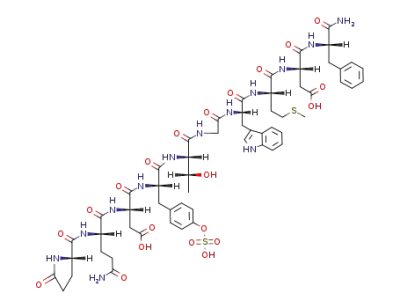
caerulin
| Conditions | Yield |
|---|---|
|
|