Home > Products > API Peptide
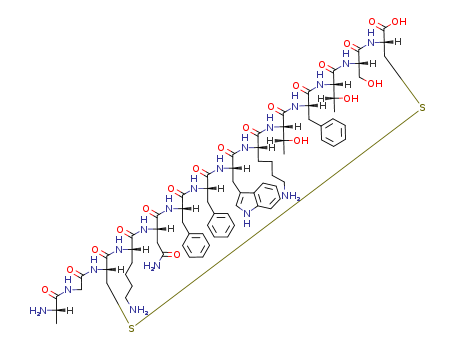
MF: C76H104N18O19S2
Appearance: White powder
|
Biological Functions |
Somatostatin is a cyclic 14-peptide that was first isolated by Guillemin in 1973 and is probably the most thoroughly investigated and most important of the inhibitory factors produced by the hypothalamus. The principal activity of somatostatin, which is of hypothalamic origin, is inhibition of the release of growth hormone (GH) from the anterior pituitary. Too much GH, as in pituitary tumors, causes acromegaly, a form of giantism. On the other hand, too little GH leads to dwarfism. Somatostatin also has been found in the pancreas and the GI tract, where it inhibits the secretion of both insulin and glucagon from the pancreas as well as the secretion of a variety of intestinal peptides (e.g., gastrin, secretin, pepsin, and renin). The short half-life of somatostatin, which is less than 3 minutes, has precluded its use as a therapeutic agent. Many derivatives of somatostatin have been prepared to increase its duration of action and/or to enhance its selectivity of action. The culmination of these structure–activity studies was the development of octreotide acetate. |
|
Biochem/physiol Actions |
Somatostatin regulates the secretion of hormones and bioactive peptides. It acts as an inhibitor in the digestive tract by inhibiting gastrin release. In the pancreatic islets, it inhibits glucagon and insulin release. Somatostatin and its synthetic analogs have been used in the treatment of neuroendocrine tumors. |
|
Purification Methods |
Somatostatin is a tetradecapeptide which is purified by gel filtration on Sephadex G-25, eluting with 2N AcOH, and then by liquid partition chromatography on Sephadex G-25 using n-BuOH/AcOH/H2O (4:1:5) and has RF = 0.4. It is a brain growth hormone releasing-inhibiting factor which has also been synthesised. [Burgus et al. Proc Natl Acad Sci USA 70 684 1973, Sorantakis & McKinley Biochem Biophys Res Commun 54 234 1973, Hartridt et al. Pharmazie 37 403 1982.] |
|
Definition |
ChEBI: A fourteen-membered heterodetic cyclic peptide comprising the sequence Ala-Gly-Cys-Lys-Asn-Phe-Phe-Trp-Lys-Thr-Phe-Thr-Ser-Cys cyclised by a disulfide bridge between the two Cys residues at positions 3 and 14. |
|
General Description |
Somatostatin (SST) is a peptide. |
InChI:InChI=1/C76H104N18O19S2/c1-41(79)64(100)82-37-61(99)83-58-39-114-115-40-59(76(112)113)92-72(108)57(38-95)91-75(111)63(43(3)97)94-71(107)54(33-46-23-11-6-12-24-46)90-74(110)62(42(2)96)93-66(102)51(28-16-18-30-78)84-69(105)55(34-47-36-81-49-26-14-13-25-48(47)49)88-68(104)53(32-45-21-9-5-10-22-45)86-67(103)52(31-44-19-7-4-8-20-44)87-70(106)56(35-60(80)98)89-65(101)50(85-73(58)109)27-15-17-29-77/h4-14,19-26,36,41-43,50-59,62-63,81,95-97H,15-18,27-35,37-40,77-79H2,1-3H3,(H2,80,98)(H,82,100)(H,83,99)(H,84,105)(H,85,109)(H,86,103)(H,87,106)(H,88,104)(H,89,101)(H,90,110)(H,91,111)(H,92,108)(H,93,102)(H,94,107)(H,112,113)
A new robust strategy was reported for t...
A trans-dibromido-Pt(IV) complex [PtBr2(...
A novel TentaGel resin supported platinu...
Platinum(iv) complexes with a heterocycl...
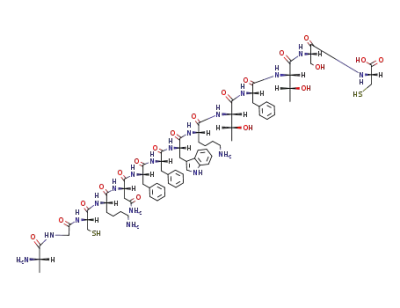
Ala-Gly-Cys-Lys-Asn-Phe-Phe-Trp-Lys-Thr-Phe-Thr-Ser-Cys

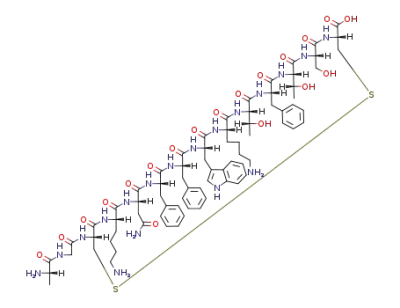
somatostatin
| Conditions | Yield |
|---|---|
|
With
iodine; acetic acid;
In
methanol; water;
at 20 ℃;
for 2h;
|
68% |
|
With
hydrogenchloride; potassium platinum(IV) tetracyanochloride;
In
water;
for 1h;
Ambient temperature;
|
|
|
With
TentaGel resin supported platinum(IV) complex;
at 25 ℃;
|
|
|
With
hydrogenchloride; trans-[Pt(1,10-phenanthroline)(ethylenediamine)Cl2]Cl2;
In
water;
at 20 ℃;
Reagent/catalyst;
Catalytic behavior;
|
|
|
With
Pt(1,2-diaminoethane)2Br4;
In
water; trifluoroacetic acid;
at 20 ℃;
for 0.0166667h;
Solvent;
|
C178H268N18O29S2
somatostatin
| Conditions | Yield |
|---|---|
|
With
chlorotriisopropylsilane; trifluoroacetic acid;
In
water;
|
95% |
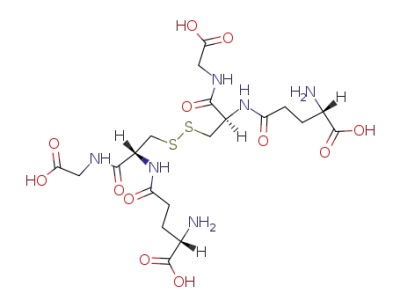
Oxidized glutathione
Ala-Gly-Cys-Lys-Asn-Phe-Phe-Trp-Lys-Thr-Phe-Thr-Ser-Cys
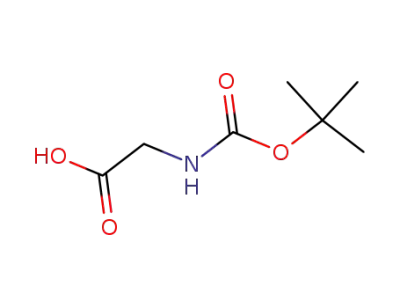
BOC-glycine
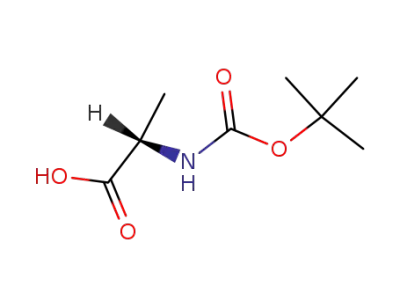
L-N-Boc-Ala
Oxidized glutathione
Ala-Gly-Cys-Lys-Asn-Phe-Phe-Trp-Lys-Thr-Phe-Thr-Ser-Cys
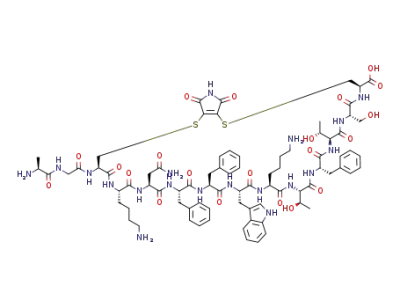
C80H105N19O21S2
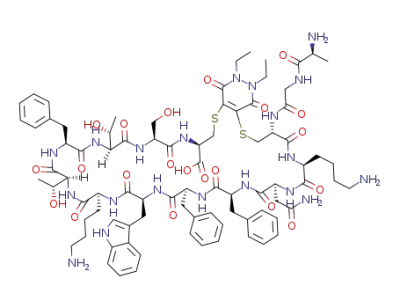
C84H114N20O21S2